
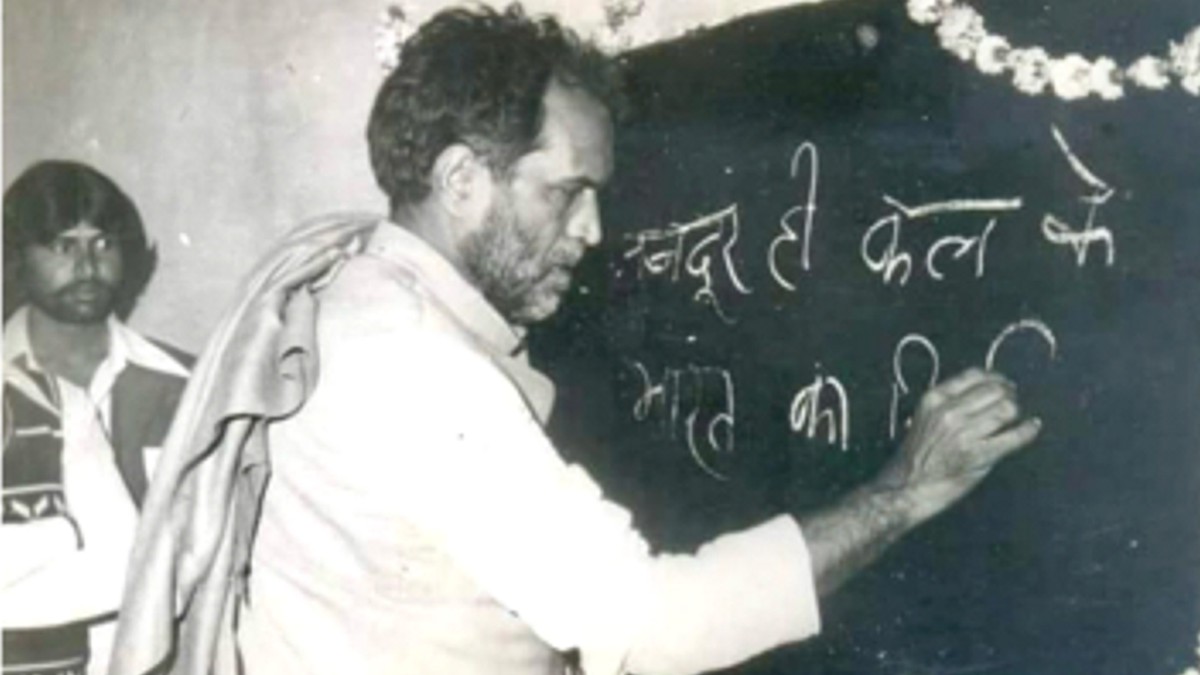
The birth centenary of former Prime Minister Chandra Shekhar offers an opportunity to understand both his political career and his ideology.
In his view, the meaning of development was defined by human dignity, labor, and social justice. Farmers, agricultural laborers, industrial workers, weavers, and artisans formed the bedrock of the Indian economy in his vision. Consequently, his discourse on labor was not limited merely to wages; it encompassed broader issues such as employment, dignity, security, and economic participation.
Chandra Shekhar regarded labor not merely as a means of production but as a force for nation-building. He believed that development should be evaluated not just by statistics on production and economic growth, but by the tangible changes in the lives of those working in fields, factories, at handlooms, and at construction sites. This perspective was reflected in his advocacy for decentralization, small-scale industries, and the promotion of local resources.
His 1983 *Bharat Yatra* (journey across India) was a pivotal event in his political life. The objective of this *padyatra* (foot march), spanning over 4,500 kilometers from Kanyakumari to Rajghat, was to reach out to the people and understand their problems. The journey deeply connected his political thought with the realities of rural India. While witnessing issues related to water scarcity, irrigation, and agriculture first-hand during this journey, he contemplated the ambitious vision of interlinking rivers like the Ganga and the Kaveri. His motivation went beyond mere water management; it stemmed from a broader concern to strengthen agricultural production, irrigation systems, and rural employment. For him, the challenges faced by farmers and agricultural laborers could not be viewed in isolation from irrigation, agriculture, and the rural economy.
In Chandra Shekhar’s philosophy, the ‘Right to Work’ was linked to a crucial responsibility of the democratic state. He did not favor leaving employment solely to market forces. In a labor-abundant country like India, he emphasized development driven by labor-intensive industries, small-scale production, and the utilization of local resources. The concept of the ‘Rachna Vahini’ during his tenure as Prime Minister was a practical manifestation of this line of thinking. It envisioned mobilizing a vast workforce to level the ravines and rugged terrain of the Chambal region, thereby making the land cultivable. This initiative reflected an attempt to link employment with nation-building. The idea was distinguished by its focus on engaging landless and unemployed laborers in productive activities that enhanced the productivity of the land and the rural economy, rather than merely providing them with relief.
Chandrashekhar was also concerned about the livelihoods of traditional artisans and handloom weavers. The crisis facing weavers is not merely a market-related one; rising raw material costs, production expenses, uncertain sales, and a lack of social security impact their entire families and their traditional skills. Therefore, it is insufficient to view the challenges faced by small producers and artisans solely as issues concerning ‘small-scale industries’; these problems also encompass livelihood, traditional craftsmanship, and self-respect.
The issue of child labor can also be viewed within this context of social reality. For impoverished families, the income generated by a child often becomes a matter of necessity. Consequently, enacting laws alone is not enough to eradicate child labor; addressing the underlying issues of poverty, unemployment, lack of education, and inadequate social security is equally essential. Chandrashekhar’s perspective emphasized the need to examine social problems at their very roots.
Similarly, regarding agricultural laborers, the question of minimum wages is inextricably linked to agricultural productivity and the rural economy. Without a robust agricultural economy, ensuring stable wages and employment becomes difficult. Thus, in Chandrashekhar’s view, agriculture, irrigation, rural employment, and wages were interconnected issues.
Chandrashekhar did not believe in measuring economic growth merely through statistics. For him, the fundamental question was: for whom is this development intended? If production increases but the benefits remain confined to a limited segment of society—leaving the lives of the working class unimproved—it is natural to question the social utility of such development.
His concerns regarding the concentration of capital and the mounting pressure on small-scale producers can be understood in this very context. His advocacy for *Swadeshi* (self-reliance) and decentralization was not an endorsement of a closed economy; rather, it was a quest for an economic system that would enable the nation to withstand external economic pressures by strengthening its workforce, local production, and social resources.
Today, issues such as employment, the unorganized labor sector, the rural crisis, the livelihoods of artisans, and economic inequality are once again at the forefront of public discourse. In these times, Chandrashekhar’s ideas regain their relevance. While current economic conditions differ from those of his era, his vision of linking labor and development to human dignity remains vitally important.
The most meaningful way to mark Chandrashekhar’s birth centenary is not merely to commemorate him, but to view his ideas through the lens of the lived realities of today’s workers, farmers, weavers, artisans, and laborers in the unorganized sector.
His most significant lesson is that the human being—not the market—must be the focal point of development. Labor is not merely a means of production; it is the foundation of dignity, self-reliance, and social justice. A nation’s true strength lies not in its public exchequer or economic statistics, but in the labor of the people who build its society and economy.